
The decision framework your team should complete before scheduling a single site visit
By the Business Development team at American Industries Group
Manufacturers from Indiana, Ohio, and Tennessee are already running two-country operations. Auburn, Indiana-based Metal Technologies has expanded casting and brake-component capacity in San Luis Potosí. Columbus-based Worthington Industries expanded its Tempel Steel lamination facility in Apodaca, Nuevo León. Welded Tubes, headquartered in Orwell, Ohio, added automotive tubing capacity in Monterrey. Publicly reported company disclosures document each of these moves.
These are not relocations of an entire company. They are integrated cross-border supply chains — engineering and customer interface staying in the Midwest, volume production moving south.

Why Preparation Beats Market Comparison
Most site-selection conversations start with the wrong question. Teams ask “which market?” before they can answer “what are we actually trying to accomplish?”
A market comparison — vacancy rates, rents, wage benchmarks, cluster depth — matters, but only after you have defined the problem the operation must solve. Roland Berger’s nearshoring report found that minimizing production cost was the most-cited consideration, named by a commanding majority of surveyed companies. That same report flagged that success depends on managing bureaucracy, security, supplier access, and resource availability — factors a cost table alone cannot capture.
This article gives your team a decision framework to complete first. It covers the questions to resolve internally, the operational realities the numbers hide, and the practical next step before you book travel.
The states driving this trend carry real manufacturing weight. Indiana, Ohio, and Tennessee each anchor deep automotive, machinery, and metalworking clusters, with manufacturing among their largest private-sector contributors to state GDP, per Bureau of Economic Analysis (BEA) industry data. That density is exactly why their manufacturers are natural candidates for a Mexican operation — and why their questions deserve structured answers.

The Questions Your Team Must Answer Internally First
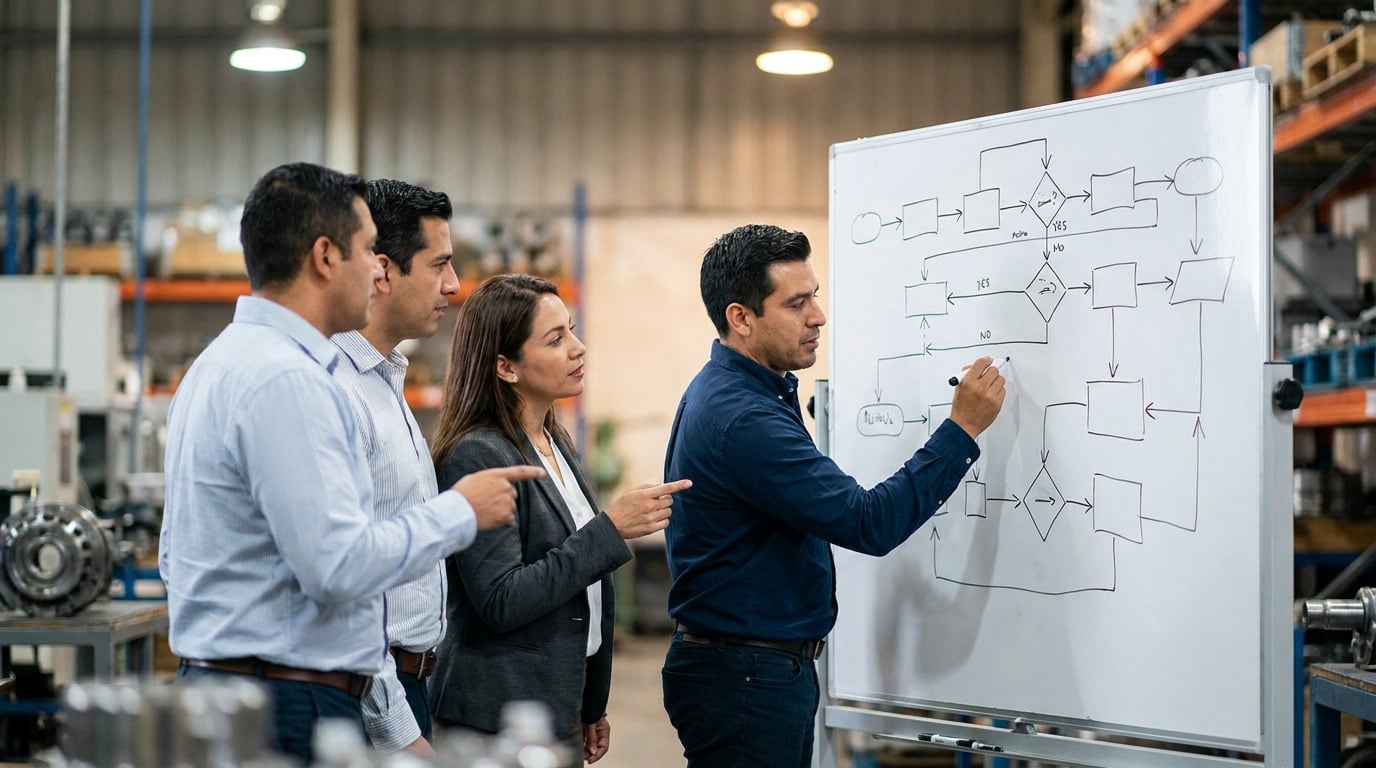
Before evaluating any location, your leadership team should reach agreement on objectives. Ambiguity here produces expensive corrections later.
Objectives drive every downstream choice. BCG’s nearshoring report on Mexico identifies clarifying cost-savings versus delivery-time goals — and your risk tolerance — as the first critical step, before any location analysis begins. A cost-driven mandate points you toward different regions than a speed-to-market mandate.
The Operational Realities Behind the Numbers
Once objectives are set, your team must probe the factors that a spreadsheet flattens. Labor cost is the headline; labor sustainability is the reality.
Fully loaded operator wages tell only part of the story. In recent years, fully loaded manufacturing labor in many Mexican regions has remained substantially below comparable costs in China and far below U.S. rates, maintaining a significant cost advantage for volume production. Mexico’s daily minimum wage stands at 315.04 pesos (about $18.13 USD) nationally and 440.87 pesos (about $25.37 USD) in the northern border zone, per CONASAMI. Peso figures converted at Banxico’s June 2026 FIX rate of 17.3744 MXN/USD. But wage level alone no longer decides location.
The deeper questions concern availability and retention. Site frameworks now score labor by tier — operators, technicians, engineers, and leadership — each with its own wage, availability, and turnover profile.
“Manufacturers seeking to diversify supply chains increasingly view Mexico as a strategic partner in a competitive global supply chain rather than simply a lower-cost alternative.”
Mexico’s manufacturing base is substantial and active. INEGI data confirms that the IMMEX (Industria Manufacturera, Maquiladora y de Servicios de Exportación) program sustains a workforce of nearly three million people employed across thousands of active establishments nationwide. That workforce depth supports the automotive, electronics, and metalworking programs Midwest firms typically bring south.
Infrastructure now rivals labor as a primary constraint. Nearshoring advisors emphasize that electricity capacity, water availability, and utility connection timelines increasingly determine whether a startup hits its launch date. A region with attractive wages but a constrained grid carries higher execution risk for automotive, metals, and food operations, since these processes depend on reliable power and water at volume.
The Operating Model Decision Sets Your Timeline
The single choice that most affects your speed to production is structural: shelter or standalone entity. Your team should resolve this before the site visit, because it determines what you are actually evaluating.
A shelter structure compresses setup dramatically. Under this model, a Mexican provider holds the legal entity, IMMEX compliance, payroll, and customs administration, while your company retains full control over manufacturing, quality, and intellectual property. Because the provider already holds the IMMEX framework — the export-manufacturing program administered by the Ministry of Economy (Secretaría de Economía) — production can begin far faster than building your own entity.
The standalone path requires more time and internal capacity. It involves incorporation, SAT tax registration, separate IMMEX authorization, and VAT-related certification before operations start.
Why Mexico’s Manufacturing Cost Structure Remains Competitive
Mexico’s labor cost advantage over the United States has remained significant in recent years, with fully loaded operator wages running well below comparable U.S. benchmarks across most industrial regions. The country also produces a deep annual pipeline of engineering graduates, sustaining a technical talent pool that supports automotive, electronics, and general manufacturing programs — often outweighing a small wage differential for automated plants.

What This Means for Midwest Manufacturers Specifically
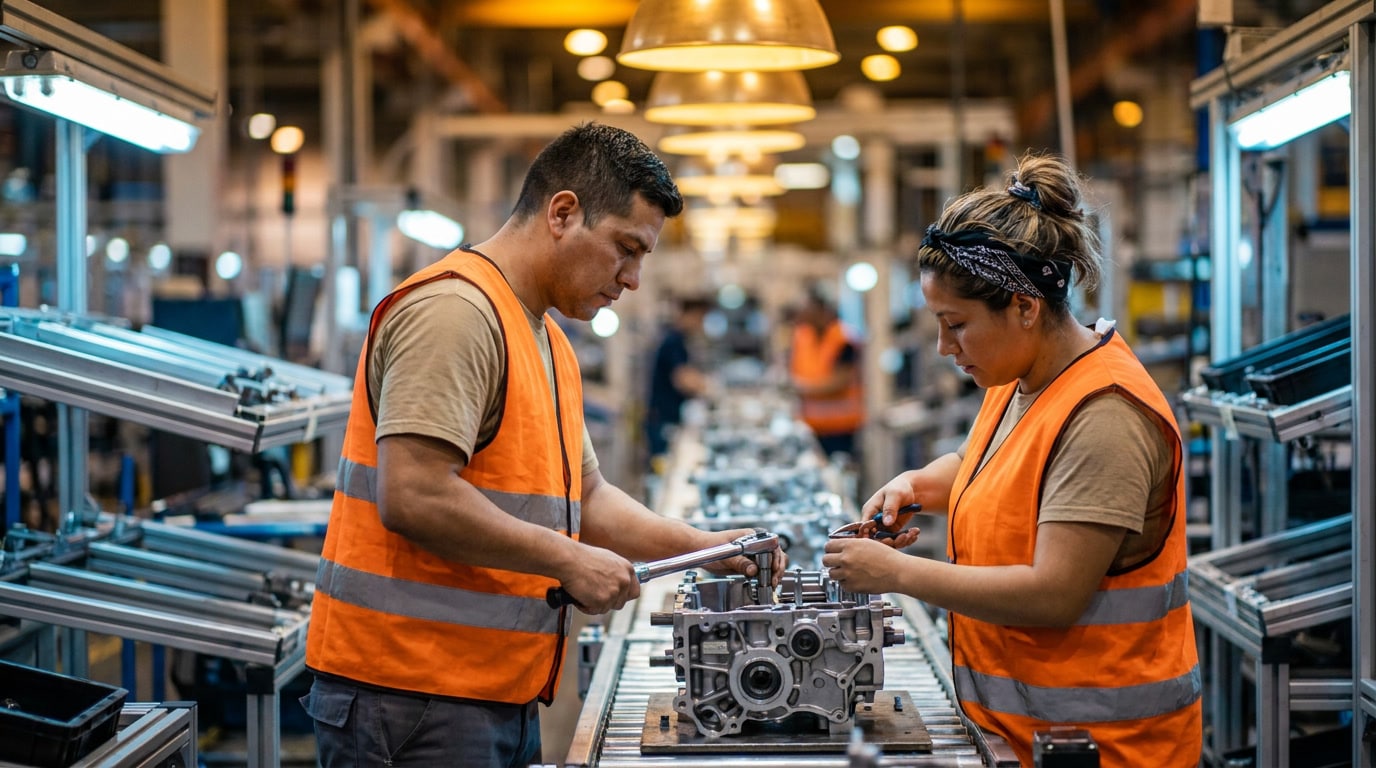
The Indiana, Ohio, and Tennessee firms already operating in Mexico offer a reusable pattern. They started small, in a proven industrial park near existing customers, and designed a dual-country operating model rather than a full relocation.
The geography maps cleanly to Midwest supply chains. Regional clusters align with specific process types, based on where these firms have placed capacity:
Short truck transit times to Midwest distribution centers, combined with the USMCA trade framework, make these corridors practical for time-sensitive components. Mexico’s manufactured exports reached $62.99 billion in May 2026, per Banxico — evidence of the cross-border volume these integrated chains generate.
The Carrier move from Indianapolis to Monterrey in 2016 remains a reference point on political and labor optics. Many firms now frame Mexican expansion as a North American competitiveness strategy that preserves — and sometimes grows — higher-skill jobs in the Midwest.
Before your team schedules travel, confirm you can answer each of these:
Where the Decision Framework Leads
Site selection in Mexico rewards teams that prepare before they compare. The manufacturers succeeding in the Midwest’s cross-border corridors did the internal work first — defining objectives, choosing an operating model, and setting a realistic cost horizon before evaluating any single location.
The next logical step is to translate these questions into a scored, structured screen your team can complete together. A decision framework that captures objectives, process split, operating model, and utility requirements on paper turns a subjective conversation into a defensible one. That preparation is what makes a site visit productive rather than premature.
The pattern across these Midwest entries is consistent: alignment on paper precedes any commitment on the ground.