China vs Mexico Manufacturing: Are You Still Competitive?
📅 July 24, 2026
🖋️ AIG Insights Team


A cost framework for Chinese exporters weighing US tariffs against relocation to Mexico
By the China Desk team at American Industries Group
A Chinese electronics exporter shipping finished goods to the United States now faces a significant Section 301 surcharge on many product lines, according to USTR actions. For semiconductors under HS 8541 and 8542, the USTR four-year review escalated the rate substantially higher still.
That single line item has changed the math for hundreds of Chinese manufacturers. The question is no longer whether tariffs hurt margins — they do — but whether the tariff cost now exceeds the cost of producing in Mexico and shipping across a land border.

What Chinese Exporters Actually Pay Today
Section 301 tariffs on Chinese-origin imports span a wide range across the original USTR Lists 1–4A, with targeted increases pushing strategic categories much higher.
Consumer electronics carry the heaviest exposure. Finished phones, laptops, and televisions under HS 8517 and 8528 face a substantial Section 301 surcharge on Chinese origin, on top of the base MFN duty, per USITC classification data. Industrial machinery under HS Chapter 84 — pumps, compressors, valves, CNC equipment — sits at a comparable level.
Strategic categories face the steepest walls. The USTR four-year review raised electric vehicles, solar cells and modules, and lithium-ion EV batteries to sharply elevated rates from lower prior levels. These increases stack on the original list rates, creating some of the highest effective duty burdens in the current US tariff schedule.
Below is a representative view. Actual duty depends on the exact 10-digit HS code and should be verified against Note 20 of Chapter 99 at hts.usitc.gov.
Representative US Section 301 Rates on Chinese-Origin Imports (2025)
Section 301 Tariff Exposure: Chinese-Origin vs. Mexico-Origin Imports (2025)
| Product Category | HS Reference | Section 301 Rate | Tariff Burden vs. Mexico Origin |
|---|---|---|---|
| Consumer electronics | 8517, 8528 | 25% | Mexico origin avoids the 25% |
| Semiconductors | 8541, 8542 | 50% | Mexico origin avoids the 50% |
| Industrial machinery | HS 84 lines | 25% | Mexico origin avoids the 25% |
| Large appliances | HS 84 / 85 | 7.5%–25% | Mexico origin avoids 7.5%–25% |
| Solar cells/modules | strategic | 50% | Mexico origin avoids the 50% |
| Electric vehicles | strategic | 100% | Mexico origin avoids the 100% |
Source: USTR Section 301 actions; rates approximate, apply only to listed HS lines, and change by USTR notice. Section 301 is additional to MFN base duty. Validate the exact rate for your HS code with a customs broker before modeling.
The differential column tells the strategic story. Goods produced in Mexico that satisfy USMCA (United States-Mexico-Canada Agreement) rules of origin may avoid the Section 301 layer, though origin determination depends on product-specific rules of origin and must be established per HS category — a point a customs broker confirms before any model is built.

The Cost Model: China Export vs. Mexico Operation
The decision reduces to a comparison between two landed-cost structures. One carries a recurring tariff and ocean freight; the other carries labor, rent, and a one-time setup.
Ocean freight adds a volatile second cost on top of tariffs. Drewry’s World Container Index recorded Shanghai–Los Angeles spot rates ranging from roughly $2,713 to $4,813 per 40-foot container across 2025, and Shanghai–New York from about $3,646 to $5,870. Spot rates move weekly with demand and carrier capacity, so any model should use scenario bands rather than a single number.
Lead time carries its own hidden cost. Ocean transit from Asia to US ports takes weeks; overland shipping from Mexico reaches most US destinations in a matter of days. Shorter transit means less inventory in transit, faster response to demand shifts, and lower working-capital exposure.
On the Mexico side, the recurring cost is labor. Fully burdened operator costs remain competitive relative to US and Chinese coastal manufacturing wages, with the exact figure varying by region and benefit level. Border clusters run higher than interior corridors.
The statutory labor burden is a planning band, not a fixed figure. In Mexico, mandatory employer contributions — IMSS, INFONAVIT, SAR, aguinaldo, vacation premium, and state payroll tax — add on the order of one-third above base salary under Mexico’s Ley del Seguro Social framework, with the exact figure varying by IMSS risk class and salary level.
PTU (profit-sharing) is calculated as a percentage of taxable profit — it is not a percentage of salary and should not be added to a salary-based labor total.

Where the Break-Even Sits
The break-even logic is volume-driven. At low US sales volume, the tariff cost stays small and setup cost in Mexico is hard to justify. As volume rises, the recurring tariff grows linearly while the Mexico setup cost stays fixed.
Three variables set the crossover point. The tariff rate on your specific HS line, your annual US shipment value, and your Mexico production cost together determine when relocation turns positive. Higher tariff categories reach break-even at much lower volumes.
The illustrative logic is straightforward: a manufacturer subject to elevated Section 301 rates faces a recurring annual duty burden that compounds against a fixed Mexico setup cost. The higher the tariff rate and the larger the annual shipment value, the faster the crossover point arrives.
This framework is illustrative. A complete cost model built on your own HS codes, volumes, and target region produces the specific crossover point for your operation.

Variables That Accelerate the Decision
Tariffs are the visible cost. Three enforcement and supply-chain risks are pushing decisions faster than the pure math alone would suggest.
Anti-circumvention scrutiny is rising. US authorities examine whether goods routed through third countries retain Chinese origin. Transshipping through Mexico without genuine transformation does not satisfy rules of origin. USMCA sets product-specific rules of origin — including regional value content thresholds that differ by category — and qualification depends on meeting the rule that applies to each HS line, not a single universal percentage.
UFLPA enforcement expanded in scope. Enforcement data from CBP shows a shift toward more frequent detentions across a wider set of shipments under the Uyghur Forced Labor Prevention Act (UFLPA), with a rising count of shipments stopped year over year. The direction of travel points to broader targeting: more shipments examined, more origin scrutiny, and less tolerance for opaque supplier networks.
Supply-chain disruption risk compounds the freight volatility. Panama and Suez constraints, port congestion, and seasonal peaks widen the ocean-rate bands. A land border with the US removes most of that exposure from the equation.

The Trend: Chinese Manufacturers Are Already Here
Chinese manufacturers are not exiting Mexico — they are recalibrating toward components less exposed to trade measures across automotive parts, electronics, and appliances.
Investment moved from volume to value. Industry cluster reporting notes that Chinese capital has concentrated in autoparts and electromobility, then shifted toward electronic manufacturing, lighting, and aluminum automotive parts — categories less exposed to trade measures when produced in Mexico. Xusheng, according to sector reporting, committed a major capital investment to a pressure-die-casting plant for precision aluminum autoparts, generating a significant number of manufacturing jobs in the region.
Electronics nearshoring gained momentum on traceability demand. Market reporting counts 17 electronics nearshoring announcements in 2024 committing more than $8 billion in capital, as US buyers demand traceable components from North American plants. USMCA regional value content rules push PCB assembly, cable harnesses, and power supplies into Mexico.
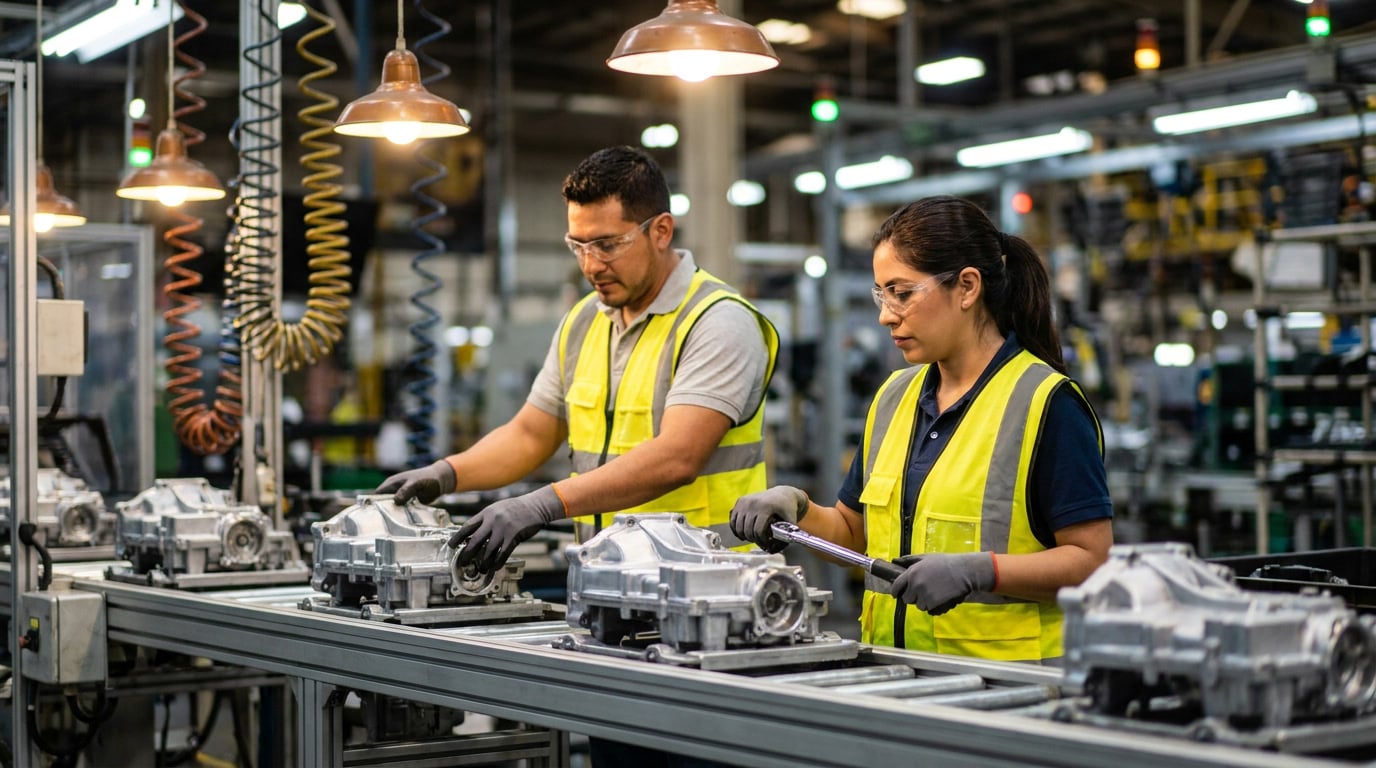
The macro backdrop supports the trend. IMMEX (Industria Manufacturera, Maquiladora y de Servicios de Exportación) manufacturing employed 2,796,738 people as of March 2026, according to INEGI, and manufacturing exports reached $64,722 million USD in March 2026, according to Banxico. The infrastructure and workforce to absorb relocating operations already exist.
IMMEX manufacturing employed 2,796,738 people as of March 2026.
How a Transition Gets Done With Controlled Risk
Relocation carries execution risk that a well-structured entry manages. The variables sit in three buckets: regulatory authorization, real estate, and workforce.
American Industries Group operates with more than five decades of operational experience supporting over 300 foreign manufacturers across 17 industrial parks and 10 operating regions. That base means the regulatory, real estate, and workforce questions a Chinese executive faces have precedent across a wide range of prior entries.

The Bottom Line for Your Board
The break-even question has a clear structure: compare your recurring tariff plus ocean freight against Mexico’s recurring labor and rent plus a one-time setup. For high-volume exporters in elevated tariff categories, the math has already shifted.
Chinese manufacturers are relocating into aluminum autoparts, electronics sub-assemblies, and appliances — a sector-specific trend backed by substantial committed capital. For exporters in high-tariff categories, the decision now turns on whether their volume and tariff exposure have already crossed the crossover point their own numbers define.